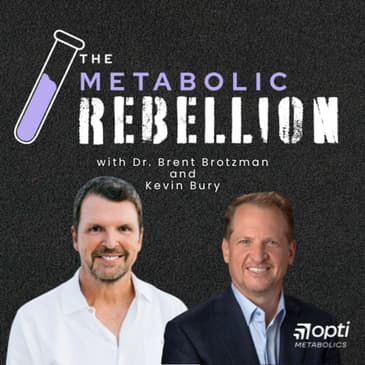
Welcome back to The Metabolic Rebellion. In today’s episode, co-founders Kevin Bury and Dr. Brent Brotzman cut through decades of diet dogma to reveal the real sources behind the rising rates of obesity, diabetes, cancer, and heart disease. They unpack why the traditional advice to “eat less and move more” just doesn’t explain what’s happening to our health - and how the calorie-in, calorie-out model misses the mark entirely.
Dr. Brent Brotzman exposes the myths that keep us stuck, from the billion-dollar campaign convincing us all calories are equal, to the hidden dangers of sugar-sweetened and artificially sweetened beverages, including their link to cancer, diabetes, and metabolic dysfunction. You’ll learn about four distinct populations who all consumed about 3,000 calories yet had wildly different health outcomes, and discover why the miracles seen in ancestral diets are missing in today’s world.
Get ready to understand how meal frequency, ultra-processed foods, and insulin resistance play a crucial role in your metabolism, and why the real drivers behind modern disease have been hiding in plain sight. Plus, don’t miss our rapid-fire hot seat, and get actionable takeaways to reclaim your health. Let’s start the rebellion against metabolic misinformation!
Timestamps:
00:00 Recapping weight loss series
03:38 Impact of diet on health
07:35 Understanding insulin resistance
12:49 Harvard study on sugary drinks
13:54 Health risks of sugary drinks
19:08 Understanding sugar and its effects
20:17 Impact of sugar and processed foods
24:21 How elevated insulin affects fat burning
27:10 Why calorie restriction can backfire
32:34 How insulin affects weight gain
35:59 Understanding insulin resistance and diabetes
39:27 Importance of ancestral diet
41:27 Why meal timing affects fat burning
45:25 How insulin impacts fat burning
48:54 Discussing population health insights
51:51 Questioning diet and lifestyle norms
55:03 Ancestral diet and metabolic health
56:51 Audience questions and topic requests
The Metabolic Rebellion: Rethinking Calories and Modern Health
Are you frustrated by the advice to simply "eat less and move more" to lose weight? You’re not alone. The latest episode of The Metabolic Rebellion podcast dives deep into the real drivers behind weight, modern diseases, and why everything you knew about calories might be wrong. Featuring Dr. Brent Brotzman and Kevin Bury, this discussion is packed with research-backed insights and actionable tips to transform your metabolic health.
Why Calories Aren’t the Whole Story
If you’ve ever believed that "a calorie is just a calorie," Dr. Brent Brotzman challenges that thinking. He explains how food is measured using a bomb calorimeter, an instrument that combusts food to measure energy. While this works in a physics lab, it does not reflect what happens in the human body 10:06. The reality is your body is an open system with countless hormones and processes, not a closed furnace burning up identical calories.
A hundred calories from broccoli and the same from soda are not processed the same way in your body. Broccoli, with its fiber and nutrients, digests slowly, avoiding sharp blood sugar spikes. Soda, on the other hand, floods your bloodstream with sugar, provoking a surge of insulin, which triggers fat storage and increased hunger later.
Modern Diseases Surge: What’s Really to Blame?
The podcast covers how rates of obesity, diabetes, heart disease, fatty liver, and even obesity-linked cancers are rising rapidly 02:16. What’s behind this epidemic? Dr. Brent Brotzman shares compelling research comparing four populations, each consuming around 3,000 calories daily. Only the modern, ultra-processed food-eating American population suffers from these diseases - all while other groups remain healthy, despite drastically different macronutrient ratios 06:32.
The culprit, according to Dr. Brent Brotzman, isn’t just calories, but the type of food, meal frequency, and most critically, how frequently insulin is spiked throughout the day 30:29. Ultra-processed foods and sugar-sweetened beverages are engineered to cause rapid blood sugar spikes, followed by insulin surges, leading to fat storage and increased hunger.
The Hidden Dangers of Sugary and Artificially Sweetened Beverages
A landmark Harvard study discussed by Dr. Brent Brotzman reveals that just two sugar-sweetened beverages per day can increase all-cause mortality by 21 percent, with significant jumps in diabetes, heart disease, and obesity-related cancers 13:54. Surprisingly, artificially sweetened drinks aren't innocent substitutes. Your body is still tricked into releasing insulin when tongue receptors sense sweetness 16:44.
Insulin: The Master Hormone Driving Metabolism
One of the biggest takeaways from the show is understanding insulin’s role in weight and disease. When insulin is high, fat burning halts, and your body shifts into storage mode 24:08. If you’re eating frequent, high-glycemic meals or snacks, your insulin never really drops, leaving you locked out of your fat reserves and perpetually hungry.
Healthy populations maintain low and stable insulin levels by eating whole, unprocessed foods, rich in fiber and nutrients, and spacing meals to allow insulin to fall 29:52. This "metabolic flexibility" means their bodies can easily access and burn fat when needed.
Actionable Tips and How to Assess Your Risk
If you find yourself stuck in a cycle of dieting, hunger, and stagnation, it’s not your fault. Most Americans are unknowingly caught in a system designed to keep insulin elevated and fat locked away 51:02. Dr. Brent Brotzman encourages everyone to look beyond calories and focus on meal quality and timing.
Curious about your own metabolic health? The podcast team at Opti Metabolics has created a free metabolic health quiz to give you a quick assessment. They also offer an educational ebook, "Eat Like a Human Again," loaded with guidance to get back to foods and habits that support vibrant metabolic function.
Listen to the Full Episode for a Deeper Dive
For anyone serious about health, longevity, or fat loss, this episode of The Metabolic Rebellion is a must-listen. Learn why traditional weight loss advice falls short and get empowered to take control of your health. For show links, the free quiz, and the ebook, check the podcast show notes and get ready to join the rebellion against outdated nutrition dogma.
Opti Metabolics - https://optimetabolics.com/
Show Website - https://themetabolicrebellion.com/
Dr. Brent Brotzman - https://www.linkedin.com/in/dr-brent-brotzman/
Kevin Bury - https://www.linkedin.com/in/kbury/
Podcast Partner - https://tophealth.care/
“Disclaimer: Informational only. Not medical advice. Consult your doctor for guidance.”
If you drink a Diet Coke, Diet Coke fools your brain, your tongue receptors say to your brain, Hey, it's coming, so we're gonna have some sugar. It so they want you to think a hundred calories of broccoli is the same as a hundred calories of Coca-Cola. While insulin is elevated, then what happens is you cannot access or burn your own fat. They're generating hunger by, you know, making you hungry two hours later. So basically what they're doing is when you look at you get deep, it's a 40 to 50 billion dollar misdirection, and it's genius. It's evil genius. Hey Kevin, how's it going, baby?
SPEAKER_00It is going well, Brent. So we got a good one today. But before we get into that, I want to talk a little bit about what we've just wrapped up. So we have just wrapped up our three-part series on losing weight the right way. And that uh series has been really well uh received. We want to thank everybody who watched that and gave us your great comments. We've gotten people from all around the country reaching out to us with comments and asking us more about our program, and that's awesome, right? The thing that tells Brent and me is that we are absolutely on the right path here, and that uh we are we're gonna, as Brent likes to say it, we are very much running counterculture to what modern medicine likes to tell you, right? So we know very clearly that traditional advice that most of us grew up on of eating less and moving more just doesn't explain what's going on, right? It's not all about calories in and calories out, and it's not all about, you know, this calorie equals that calorie. So today we're gonna go into that a lot deeper because if you zoom out and you really look at what's going on, something very clearly is amiss, right? We've got rising rates of obesity, diabetes, heart disease. I just read an article about heart disease in children now, right? Fatty liver is running prevalent, even obesity-related cancers are on the rise. Something is really begging that we've got to figure out what's going on. And that's what we're gonna talk about today. So, today's topic is and something that Brent is very passionate about is discovering the source of modern diseases, right? So, Brent, why don't I pass it to you? And let's you've introduced that kind of topic and then tell us what are the five or six things that you want our listeners to take away from today's podcast?
SPEAKER_01Great question. Here's the five takeaways I think at the end of the segment that everybody's gonna know. Number one, if I eat three to five times a day, like they're telling me to, why does it increase your cancer rate through elevated IGF 1 and insulin, fasting insulin? Number two, you know, why do uh Kevin and Bratzman on Oftimetabolics, why are they intrusive and they're looking to see how many uh sugar-sweetened beverages I drink a day? And now they're telling me that's increasing my cancer risk, my type 2 diabetes risk. And there's this Harvard study. So number two is gonna be we're gonna show you why you don't want to drink sugar-sweetened beverages. Number three is we're gonna show you four populations all eating 3,000 calories, two miracle populations, your GG Mom 6, who was kicking it back in 1900, six generations back, and then us. And we're all eating 3,000 calorie diets, but they have 0% obesity, 0% child obesity, no uh type 2 diabetes. None of the top 10 causes of death in modern lifestyle issues. It's not lifestyle, it's diet. And then we've even got a study where they, an aboriginal study where they took them back out of the Western diet and put them back in their um Australian Aboriginal um diet for a couple months and they reversed diabetes and lost weight. We got some interesting stuff on what 3,000 calories does to you in the ultra-processed era versus miracle populations versus gg mom sticks. Also, we're gonna talk about some really cute rats population study where they basically took two sets of rats, equal calories, equal exercise, equal macro distribution, but they changed one thing and half the rats were fat, half of them were lean like our ancestors. That's being interesting. It had nothing to do with calories, equal calories. Then we're gonna take it from cute rats to cuter children. Another study by Ludwig that shows that if you feed a child a high glycemic blood sugar spiking breakfast versus a low glycemic low blood sugar spiking breakfast, that um the high glycemic breakfast kids um in the next five hours ate 51% more than the low glycemic, and then over the course of the day ate 81% more. Why? What was it about that high glycemic breakfast? It's the standard American breakfast. Hey, American Heart Association approved honey nut Cheerios with the sugar and the fiber removed from it, you know, and a nice glass of orange juice. Why does that make you eat more calories when you go into hint? When you go into hypoglycemia because your blood sugar spiked, your insulin spiked, and now you're hypoglycemic and you're hangry three hours later, you're gonna have a muffin. It's engineered that way, and we're gonna show you how that works.
SPEAKER_00All right, that's great. And then you can't escape. We got some really good feedback on putting you on the hot seat. So we're gonna put you on the hot seat at the very end. So that's that sounds great. We as you like to refer at the stump on the stump the chump, I think is what you called it, right? So in our in our opening, I posed the question of what was the difference between these four populations uh that all consumed about 3,000 calories a day, yet three of them didn't have any of the signs that we see today of things like obesity or diabetes or cancers or dementia, all these sorts of things. So let's start there. Let's talk about what those four populations are, Dr. B, and what were the differences in why one of them is uh pretty much habitually sick and dealing with all these chronic illnesses, and the other three didn't experience any of those.
SPEAKER_01So all four populations are eating 3,000 calories a day. Um, and nobody's uh um top VO2 Macs are running marathons. In fact, Gigi Mom 6 basically didn't even have tennis shoes yet till 1920. So she's trekking around barefoot or in some kind of cod hoppers. So we got Gigi Mom beat on her, you know, calories in, calories out exercise. And the other two populations are walking around some. So uh same calories out, same 3,000 calories in. So the first population is eating predominantly almost 75% carbs. It's the Papua New Guinea uh Kativa Island, I never pronounce it right, but well studied, and we'll show you who studied them. Uh but they're a miracle population. So they have 0% obesity, no type 2 diabetes, no athoscrotic cardiovascular disease, no childhood diabetes, which is rampant with us. When uh essentially no cancer during the time they were studying them. So totally the opposite of us. And they're eating 75% uh carbs. Then I picked another miracle population, which is uh the Maasai, back in the 1960s when they were being studied in Africa. And they're totally the opposite. They're like, they're basically the modern day uh lean mass hyperresponder, and they're eating tons of fat, tons of protein. They're eating all day long, they eat meat and some cow's blood, weird stuff, but they would be considered, you know, very much protein and uh fat. Then you've got gigimom, and again, 3,000 calories and none of the modern day diseases. Very well studied. What's going on here? Then you've got uh GG Mom who's kind of a hybrid, so it's your genetics. It's nobody in cool exotic places, it's not a blue zone, purple zone, red zone. Gigi Mom here in the US, and she is uh same thing. She is 3,000 calories, no exercise, because it back then you didn't jog, didn't do CrossFit. And she had a 1.2% obesity rate on the studies, but again, had no type 2 diabetes, no atheroscorotic cardiovascules, no childhood obesity, and none of the top 10 causes of mortality that we have that are reading tons of literature, you're probably starting to hear stuff about insulin resistance syndrome. And there's some good work where they're showing that top 10 causes of mortality, excluding trauma, excluding uh upper respiratory infection, are all tissue-specific manifestations of underlying insulin resistance syndrome, which in English means you got 22 tissues, and each of those tissues in your body responds to insulin, kind of the master hormone, in a different way. And especially insulin, if you're eating a bunch of sugar-spiking, ultra-processed food, uh, sugar-sweeting beverages, and you're getting too much insulin produced by your pancreas, then eventually the cells get sick of it and say, hey, stop it, and that's insulin resistance. So uh the top 10 causes of mortality and the top 70% of chronic disease are tissue-specific uh responses to too much insulin or insulin resistance syndrome. That's Casey Means, that's Ben Bickman. That's not Brent Bratzman, that's a you know, a bunch of good research on that. And so now it starts getting interesting. So everybody's eating 3,000 calories, but why are we so sick and we have all the modern-day diseases which are um insulin resistance, tissue-specific um manifestations, and they don't have any of that on 3,000 calories?
SPEAKER_00So we've got four distinctly different populations, right? One's pretty heavy carb, another one's pretty heavy fats and proteins. One is basically us 125 years ago, but without all of the ultra-processed, all of the seed oils, all of the things that make the modern standard American diet, and now this becoming the standard world uh diet. And then you got us. And us uh being our generation suffering from obesity, type 2 diabetes, all these things. So let's talk more about that, right? We've talked about how it's not calories in and calories out. Clearly, they all are in the uh 3,000 calories. So tell us more about why that is and what are the takeaways for our viewers on that.
SPEAKER_01Do you want me to give away the$40 billion misinformation campaign right away? Okay, good. I'll do it. When you're talking about a calorie, it's kind of it's calories are cool. So I've gotten to do this a few times. So when you're looking at calories of food, what you do is you get a big this big steel, the coolant's have a plex glass, you get this big bomb calorimeter, and then what you do is you put in, you desiccate or dry the food, and then you put it into the bomb calorimeter, then you suck out all the air, you put in pure oxygen, you put a kind of igniting thing on top, it's a a bomb per se. And then you ignite the pure oxygen and the food, and it's a combustion thing, like you know, a car, you know, you oh, a car cellar, here comes the oxygen, you know, and I'm gonna explode. So it's an explosion. So it's basically a combustion deal where what happens is when it the thing bomb thing bomb basically combusts, then it measures okay, how much heat was produced, how many calories did it go up in the heating of the water. So that's really cool, man. It's fun to do. I've blown up a bunch of them, but here's the deal has absolutely nothing to do with how your body handles, you know, food. It's nothing to do with human physiology, but it's a beautiful misinformation campaign because one, you know, carries in, carries out. So if you're not, hey, restricting calories, you need to either run more or you need to eat less because uh caloric restriction diet's gonna do it, and it's not. You'll see. Number two is it says, oh, all calories are the same. So they want you to think 100 calories of broccoli is the same as 100 calories of Coca-Cola. The problem is it is in the bomb when you're blowing them up, but has nothing to do with human physiology. They're not the same at all. One of them gives you a big blood sugar spike, a big insulin spike, then you're hypoglycemic, then insulin puts it in the fat. The other one's got broccoli, it's got lots of fiber, it goes through slowly, they don't get a big blood sugar spike and then the spike, and you'll see that that's important. So it's their way of trying to blame it on you. If you're gonna lose weight, all these calories are the same in your body. They're the same in the physics lab, they're the same in a closed system. If you call up your high school um physics teacher and ask her, does this apply to open systems with uh 50 hormones and energy partitioning and anti-starvation and a hypothalamus switching back and forth between, you know, ketosis, uh glycogen, um, carbs, burning fat, has nothing to do with it. Wow.
SPEAKER_00I've heard you talk about the closed system that we are not and that we are a beautiful open system. That makes all the sense in the world. So, Brent, I know you've talked a lot about this. I hear you talk about it with our members, and I've heard you give speeches on it. But Dr. B, this is like pretty revolutionary, right? Like, where's the science behind this? And I always love the fact when you can produce the scientific evidence. So why don't you tell us where your science comes from in what you just explained?
SPEAKER_01Okay, great. So let's start out with a Harvard study. It's long-term consumption of sugar sweetened and artificially sweetened beverages and the risk of mortality in the US. So I want you to start thinking about this. Well done, Harvard study, 100,000 patients over a 30-year period of time. They looked at uh 3.4 million uh personners of life during this. And basically, what they're looking at is if you drink uh sugar sweetener artificially beveraged, if you have two um two per day, and again, this is including this also includes orange juice, apple juice, Gatorade drinks, does sadly the smoothie that you grind up and you think it's healthy. Yeah, I know. I can't tell you how many SIE bowls or smoothies I ate for uh rather than these studies. But anything that's rapidly spiking your blood sugar, rapidly spiking your insulin. If you drink two sugar sweetened beverages per day, uh a healthy orange juice for the morning compared to somebody who doesn't, over this 30-year period, well done study controlled percloric intake and physical activity. If you drink two a day, you have an orange juice of Diet Coke in the evening, it increases your all-cause mortality by 21%, your cardiovascular mortality by 31%, your type 2 diabetes rate by 67%, your coronary heart disease by 29%, your cancer risk by 18%, your obesity-related cancer is to 13, one of them is uh breast cancer, 22% increase on obesity related cancer, and it drops your life expectancy somewhere between four and uh six years compared to the person who's not drinking the drinking the two sugar-sweetened beverages a day. So that's interesting. You know, nobody's telling that on the cowrie thing. They want to say two 100 calories of uh soda is equal to 100 calories of broccoli. I'm gonna throw in one other one. Here's a study, we'll pull it up for you. So you see at the top it says sugar-sweetened beverages, and it's a study on cancer from uh sugar-sweetened beverages, and it gives you some mechanisms. So if you're drinking them with a rapid blood sugar spike and insulin spike, it shows how in this paper it causes obesity and then to cancer through a circuitous pathway we're gonna talk about. It increases your inflammation and it's predominating your visceral fat or your abdominal fat. And uh, it's through uh a lot of these uh cytokines, like in this case in this paper, it's IL6, interleukin 6, which we in our 85 labs pull up for you and show you. So in this paper, you see that's also the cancer. And then through IGF1, we were just talking about insulin growth factor one. So if you're bumping up your insulin to cover these sugar-sweetened beverages, it also increases your IGF 1 all day long. So that's a progression of cancer, and then a bunch of oxidative inflammatory stresses. We'll get into some of our cancer talks. So basically, the take-home here is I'm thinking that two sugar-sweetened beverages a day compared to 100 calories a day, compared to broccoli, something seems amiss.
SPEAKER_00So that's mind-blowing, right? And I've seen the studies before as you've had me read them. It every time you talk about it, it just it baffles me. So we have studied this extensively. Harvard, one of the most prestigious search universities in the world, has studied this, and it's two sugary drinks. And by the way, that is not just a soda, that's to your point, whether it's an energy drink or these orange juices and these juice boxes and things like that. There's one thing you didn't talk about in there, Dr. B, and I know that's because you and I have talked about it extensively. Not just a sugary drink.
SPEAKER_01Oh, yeah, it's also artificially sugared, as you see at the top of the It's your diet sodas, it's your sugar-free and zero.
SPEAKER_00So when you drink a Red Bull, zero, and I'm not picking on Red Bull, but when you drink things that your system thinks is sweet, it has this cause.
SPEAKER_01Absolutely, because the mantra is, well, hey, if you drink a Diet Coke, and I can in my surgical training, I don't like coffee, sadly. It turns out that's it's actually healthy. So I was drinking all these Diet Cokes to try to get the caffeine to stay awake, but turns out Diet Coke fools your brain. You know, your tongue receptors say to your brain, hey, it's coming, so we're gonna have some sugar. And so you still get the cephalic phase, and so your your pancreas still puts out a big bolus of insulin. It's not quite as bad, but it's still it in this study, it's just as bad. So some studies say it's a little better, but you're still on the same pathway of big insulin problems.
SPEAKER_00Well, let's move on from that. So that's I hope opened a lot of people's eyes. So we've covered sugary and and sugary-like drinks, right? So, okay, let's talk about the rats and the cute little rats, as you'd like to call them, the cute little rats, and then we'll move on to the cute little kids, right? So let's start with the rats.
SPEAKER_01This study was done by Ludwig et al. I think it was in the Lancet. We're gonna have it pulled up for you. So he took rats, he divided them into two groups, and what and interesting, so he fed them the same amount of calories in both groups, equivalent calories, and they gave them the exact same macronutrient ratios, so same carbs, same fats, same proteins, same exercise. So calories were equal, exercise was equal, macros were equal. And but they changed one parameter between the two groups, and that is on one of the sets of rats, they gave them high glycemic, high blood sugar spiking, high insulin spiking, and we'll talk about that in a second, carbohydrates as their carbs. And then the other group, that's your ultra-processed food. So ultra-processed food has added sugar. It they take out the fiber purposely to give you a good blood sugar spike. So, uh, or it's it's ultra-processed food or sugar-sweetened beverages or artificially sweetened beverages would be the version of what he gave them. So they give them high glycemic, high blood sugar spiking, insulin spiking uh carbs. The other group they gave low glycemic carbs. So essentially that's like your broccoli, a cauliflower, something that's a whole food that you get from the ground that your ancestors eat and the miracle populations eat. So it has lots of fiber in that set of carbs. So it slows down your digestion and your digestion tract. So you don't get a big blood sugar spike, you don't get a big insulin spike. And so guess what? The group who were the low glycemic carbs had no obesity. The group, the rats that ate the high glycemic carbs with the big blood sugar spike and a big insulin spike were very obese. So it had nothing to do with calories, had nothing to do with exercise. It was purely what type of carbohydrate was it, high glycemic or low glycemic.
SPEAKER_00All right, Brent. So that's fascinating. I gotta tell you, every time I tell you I hear you talk about that, it blows my mind to know that we know what's going on here, and yet we keep doing it to ourselves, whether it be through the the sugary sodas and the drinks and things like that. And by the way, we are all, not all of us, most of us, are addicted to that kind of stuff. I know I used to be like you did, at least coffee with heavy sugars and things like that, and it's the same basic concept, right? But when you talk about the kids, the kids where we feed them what they think is a heart healthy, right? Because it says it right on the box of the cereal, it's heart healthy. And then those kids, because they get that big spike and then they get hypoglycemic, and then they're going to eat more, which then leads into yet more insulin. So that begs the question. And I know you're very passionate and knowledgeable about this next topic. Let's talk about what really is insulin and what is its role in helping the body deal with all this sugar that we continue to take in via our sugar via our food. So let's talk a little bit about what that is, and then I want to know about what the healthy populations do versus what we do.
SPEAKER_01Well, we're taking in about 150 pounds of sugar a year compared to Gigi Mom, who was about eight, and these ancestral populations were or the miracle isolated populations were just eating whole foods, you know. I'll tell you, you can beat yourself up a little bit, but if you're being told in the energy balance paradigm, hey, look, uh 100 calories of broccoli is uh same as 100 calories of coke. And if you do zero calories of uh diet, then you're doing yourself a service and you're counting your calories and restricting, then that's a problem. But we're we'll have another uh talk we're gonna have where basically it shows that the huge uh childhood obesity. Now teenagers uh are getting so much of their calories compared to 1970 from the uh sugar sweetened beverages, the energy drinks, that you know, one in three uh adolescents in America has uh pre-diabetes, and we've got like one to five to one to four of our kids are obese. And again, it's not because they're playing too many video games, it's because of what the diet's doing to them. Because those perfectly parallel, if you strip the fiber out of ultra-processed food and add sugars, and you get a rapid blood sugar spike on purpose so that you get a blood sugar spike, insulin spike, and you're hypoglycemic. And we're eating 60% of our calories are coming from ultra-processed food that's uh you know, stripped of fiber. And these kids are uh getting a huger and huger proportion of their um uh intake through the sugar sweetened beverages. So that's what's going on. So I think to this point, yeah, it's a great segue, and let's say this. So we got four populations, 3,000 calories, but a whole different food source, and you're I'm about to reveal that. I don't know if Is a word we use at rapidity, or it's the rapid blood sugar spike that comes from glycemic blood sugar spiking, insulin spiking carbohydrates, and it's not from the calories. So the rats had equal calories. So now I need to make you an expert in human physiology. It only took me years to get this, but I'll give it to you in two minutes. You need to know the next sequence before we start getting into what the miracle populations do. The next thing is what does insulin do and what are its properties? So remember, your body, you've got a pancreas, it's uh two million years old, not used to seeing uh 60 grams of sugar. And so your pancreas was seeing, was eating some animals, some fat, some protein, and it would come along uh, oh, here's some berries on the ground, but it wouldn't uh chew up the berries in a blender and make it into smoothie, or there was no sodas. So your pancreas is not kept up with your brain. So what does a pancreas who has beta cells and produces insulin, what does insulin do? Well, number one, when you get a big blood sugar spike like this, your pancreas produces insulin to get the blood sugar spike back down. Because if it doesn't get it back down, then you're essentially gonna have type 2 diabetes, which is too much blood sugar in your bloodstream. So number one is big rapid sugar spike from ultra-processed food or sugar, sweet and beverage, big insulin spike to get it back down. And we'll we're gonna put a study up here that shows that if your fasting glucose is 85 or less, then you're fine. But if it's above that, you have a 40% increase in cardiovascular death. So it's important to be able to get insulin uh to get your blood sugar down. So you rapid spike, rapid uh insulin. Here's number two. Insulin is a storage hormone and it's gonna store it first as glycogen, but then as fat. Very quickly, it goes from glycogen to fat. So if insulin is elevated, we can go through all the enzymes on another deal, but it is going to put big bolus insulin's immediately gonna put all your energy into fat. Number three, and this is really important, while insulin is elevated, then what happens is you cannot access or burn your own fat when insulin's elevated. So if you eat a big glycemic meal, big sugar spike, big insulin spike, then what happens is of course it's gonna stay longer. Your sugar goes down, and now you're hypoglycemic. That's how they're generating hunger, making you hungry three hours later. But then your insulin keeps staying in the bloodstream. And guess what? For the next uh after a glycemic meal, we have all kinds of studies for the next 12 hours, 10 hours, depending on how much, you cannot burn fat. So if you say, I'm going on a diet or I'm gonna go exercise, it does uh lipogenesis where it stores it in fat, and it does lipolysis where it blocks access to your fat. And it's blocking an enzyme called hormone-sensitive lipase. That is critical, you're about to find out. And then it's gonna knock down blood sugar, it's going to store it away as fat, it's gonna inhibit you from burning your fat, which is what you want to do when you're on a diet. You want to burn fat, not your body or your muscle. And then the last one is insulin also is a kind of a growth, it's an anabolic grower. So basically, if insulin's elevated, then it's growing cells. So if you're in puberty and you've got elevated insulin, that's great. But if you're drinking a couple sugar-sweetened beverages and you're eating processed food and your insulin's up all day long, IGA1, then what happens is no autophagy, and you start getting into the, we'll put these studies up, the elevated insulin all day long, grow cells too much, they don't have autophagy, that's cancer. So one of these studies we'll show you shows that the average American's insulin, fasting insulin is 10 to 12, and our healthy ancestors were four to six. You can only burn your fat if your insulin, it's a gradation, but if your insulin is below six or below, you can burn your own fat. You have access to it. If it's 10 or 12, then you your insulin is still blocking your ability to burn your own fat. So there's here's where we start getting into caloric restriction is if your body thinks of energy availability. So if you are eating glycemic meals all day long, insulin's up all day long, you're putting away his fat, and then it can't, you know, it's blocking HSL. Bob here is restricting calories long. He's on a calorie restriction diet. And Bobby says, I need to burn some fat, but then the HSL says, Hey, I can't. Insulin is blocking me. Then that's when you see, we're gonna show you on America's Biggest Loser calls NIH study, where they looked at them and 13 of the 14 folks had gained all their uh weight back uh at six years. So what happens? The first thing the body's gonna do is anti-starvation mode. Okay, my insulin is high. We'll give you more on that. I can't access my fat. So I'm gonna starve to death because I don't have any energy stores, and it's thinking about energy availability. That's when your body slows down your resting metabolic rate, about 700 calories, because it thinks it's starving, doesn't have access. So it's adaptive thermogenesis. One, it's your body temperature goes from 98.6 to 97. Two, your hypothalamus tells your thyroid, hey, a little less T4, a little less T3. We gotta, we're idling down here because we're about to starve to death, but there's no buffalo running. Also, there's some other things it does. So, and on the NIH study, they did the eat less, move more, they restricted calories, but their insulin was still elevated, so they couldn't access their fat. So their resting metabolic rate went down uh 700 calories and six years later had not come back up. So, unless we're at Optie, we have a lot of folks who are mitigating that because your body says, Hey, I was about to starve to death for once, I'm gonna stay down to this item mode because we may starve to death again. And then finally, what happens is if you're eating a thousand calories and it can only get down to burning 1400 calories and it's gonna do that to 2,000, the other 400 calories, your body uh starts eating the only thing it has left, which is your muscle. It starts taking your amino acids out of your muscle. That's uh gluconeogenesis. So what happens is if you go on a if you're eating the standard American diet and your insulin level is 10 to 12, it's too, it's not allowing you to access your fat. You're gonna go into adaptive thermogenesis and lower your resting metabolic rate, and then you're gonna eat your muscle, which is exactly what we're seeing with all the Wagobi folks, and we predicted it for our clients because they're in a uh starvation diet or we calorie restriction diet. Remember, Wagobi and all that, the way they act, they don't lower your insulin. Number one, they give you an appetite suppression through your dopamine uh pathway. Number two, they slow down your GI tract. So it's very effective caloric restriction. But if your diet is very glycemic and it's keeping your insulin high, and insulin is blocking your ability to burn your own fat, then that's why they're having the same thing. We'll throw some of these uh studies up here. So just like the caloric restriction of eat less, move more with America's biggest losers, in the Kenneth Islands, what happens is they're eating twice a day and they're eating predominantly carbohydrates, but their carbohydrates have lots of fiber in them. So their whole food's out of the ground. So basically they're eating tubers and berries, we'll put up on the screen, but stuff with good fiber. So and they're eating it twice a day. So what uh time-restricted feeding, they're not eating six times a day, keeping their insulin up. So to be metabolically flexible, you have to be able to burn your own fat. That's what that means. Societies or populations that are metabolically flexible are able to burn their own fat when they want to. So, and your fasting insulin has to be six or below. There's gradations six to eight. But let's say six. So if your fasting insulin is six, it's not going to inhibit you from burning your fat. It's not gonna inhibit HSL, the enzyme that lets you cleave your fat, send it to your liver, and then turn it into ketones. So here's what they did: they ate whole foods, all their carbohydrates were had fiber in them, and the fiber slowed down the absorption through the GI tract, didn't allow a big blood sugar spike, didn't have a big insulin spike, and so they didn't put anything away in fat and they weren't inhibited, insulin went down, and then they'd eat their next meal. The same thing in a different lens is going on with the uh folks uh in the Maasai. And so what happens is they're eating protein and fat. But we'll show you on this curve. If you eat protein, you get a little bit of a blood sugar spike and a little bit of an insulin spike. If you again, if you eat carbs with fiber, a little bit of a blood sugar spike, a little bit of insulin spike. Eat carbs with that are highly glycemic, big sugar spike, big insulin spike. And then if you eat fat, almost no blood sugar spike. So in Africa, in psi, basically they're eating two meals a day. Their insulin goes down between the meals, it's not, you know, staying up for uh eight, 12 hours, and they're eating non-glycemic, the protein in the fat are not glycemic. So basically the same thing. Their fasting insulin put out by their pancreas is six or below. So the problem with uh standard American diet is you're eating four to six small meals a day, so your insulin's always on and it's always putting away enough fat and keeping you from burning fat because you're eating blood sugar spiking, insulin spiking carbs. So then when you want to go, so you say, hey, I'm gonna calorically restrict, so I'm eating a glycemic diet, a blood sugar spiking diet multiple times a day. I'm gonna eat less of it. So instead of 2,000 calories, I'm gonna eat 1,500 calories. Well, it's still enough to keep your insulin elevated. The average American's fasting insulin uh is 10 to 12. So that's when you get into a problem with starvation mode because your body's uh it's all about energy availability and partitioning. So you and I want to burn fat when we go on a diet, but since our insulin is still elevated, it's putting it away into lipogenesis, fat formation, and it's inhibiting fat burning. So that's when the body says, I don't have energy availability through my HSL hormone, cleaving it, so I'm going into starvation mode. So that's why everybody, unlike the physics equation, where if you're losing a pound a day in the physics lab on the calorie thing, you should go down to zero pounds. That's why everybody in America basically you start dieting, you lose some weight for about six weeks. Uh some of it's fluid, some of it's uh a little bit of thing, and then at six weeks you go into adaptive thermogenesis and you you plateau out because you're in starvation mode.
SPEAKER_00All right, Dr. B. So, as always, your explanations, your depth of knowledge and stuff are blow me away. But for those of us who are not as much into the science as you and understanding all this, what would you say for someone that said, okay, I I get it. That's really intense, really deep. Give me the story of insulin for dummies, right? Because I gotta go try to explain this to my wife or my husband. I need to be able to explain this to my family. What would you have me say so that I can really help them understand what's going on?
SPEAKER_01Okay, how about this? It's not about calories. There is no obesity without elevated insulin. There's a couple of rare exceptions, you know, certain tumors, uh, certain drugs, but essentially you cannot be obese without uh elevated insulin. Insulin is going to bring into your cells, and it's going to, if too much of it, you're going to be gain weight as fat. Your pancreas uh secretes insulin uh when you eat meals, every time you eat a meal. If you eat um protein, you get a little bit of a blood sugar spike, a little bit of an insulin spike, as we told you, because it's trying to keep your blood sugar down. You eat fat, very little blood sugar spike, very little insulin spike from your pancreas. You eat carbohydrates with some fiber in them that slows down the digestion of your GI tract, that's okay. You don't get much of a blood sugar spike, you don't get a uh much of an insulin spike. But if you eat a sugar sweetened beverage or a um ultra-processed food with a fiber stripped out of it on purpose with added sugars, get a big blood sugar spike and your pancreas in the body says, Oh, snakes, I gotta get this down. You know, I just spiked my uh blood sugar to 130, I gotta get down to 90. So that's when you get a big insulin spike. And then it stays longer, and then you get hypoglycemia because it keeps getting them into the cells, and now you're hungry. That's how they generate hunger. So it's not calories. 100 calories of broccoli is not equivalent in your body to 100 calories of coke. So these miracle populations, the guys with carbohydrates are eating whole foods twice a day. So that's time-restricted feeding. So they eat broccoli, and so they don't get much of a blood sugar spike or insulin spike. And then six hours later, insulin's down, and they eat broccoli some more, and so their fasting insulin is low. So they are metabolically flexible. If you have a low insulin, then you can access and burn your body stores. You're it's not inhibiting HSL. If you have a high insulin, you cannot burn, it's putting everything into fat. So, how did they how are they so miraculous? They ate two meals a day, time between them, and they ate meals that didn't spike blood sugar rapidly and insulin. Same thing with the guys eating uh protein and fat twice a day, the masay. They got a little bit of a blood sugar spike, a little bit of insulin spike. They had time for the insulin to go down. So they can access their own fat. They can burn it. You and I, you know, standard American diet, we're eating four or five, six times a day. They've stripped out the fiber and they've added sugar and they've given you sugar-sweetened beverages. And so your pancreas is working overtime. Oh God, Dr. B spiked sugar with uh big uh Coke or diet coke or ultra-processed food, big sugar spike, big insulin spike. Now I'm hypoglycemic, it's making me hungry, and I'm doing it six times a day. That's the problem. It's not, they're not calorically the same, it's the way your physiology reacts to it. One last thing. That's how I come back. I told you I was gonna tell you on the Harvard study, how do you get uh all these things from sugar sweetened beverages? Your pancreas can only do so much if you're doing this all day long and the pancreas, the beta cells can only produce so much. Over time, it just can't handle it. Your primary care is only looking at your blood sugar, he's not looking at your like we are in our 85 labs and your personal history. We're looking at your how many sodas you drink and all that. So, what happens is they say, hey, your blood sugar is fine, but your insulin's going up and up, so you're becoming obese. And eventually your beta cells can't handle it, and then they just they kind of die off, and you're eating so many blood sugar spiking meals. That's type 2 diabetes. It's not that you don't have a pancreas, it's that your pancreas got overwhelmed by the diet. That's where we start getting to all the scientists on the insulin resistance syndrome. Ravens described it in 1988, and uh Ben Bickman does a great job in this book, Why We Get Sick. But essentially, it's this 22 tissues in your body, every one of them responds to insulin. But if you have elevated insulin all day long from the diet, each one has a tissue-specific response. So, type 2 diabetes is insulin resistance of your pancreas, Alzheimer's disease and dementia associated with diabetes is insulin resistance of your brain because there's so much insulin that your brain cells say, Oh my God, and they downregulate and then they can't get glucose in. And we're gonna we have a bunch of stuff on that. So we're looking at our dashboard, we're looking at all your risks for diseases. So we're saying, here's your genetic component, and here's hey, you have insulin resistance, it gives you a risk for having diabetes. Here's the studies, and then we modify your diet. So these 22 tissues, each one of them has a different response, and we're gonna be going over these. But there's nothing not, that's not my research. That's just us making sure we're on top of it.
SPEAKER_00Let me pause for just a moment because if you're listening to this conversation, you might be having the same realization that a lot of our Opti members had when they first found out about us and joined us, right? That no one has ever really shown me what's happening inside my metabolism. And that's exactly why we built Optimetabolics. See, Opti is not a diet program, it's not a program at all, right? And it's not just another stack of expensive, advanced labs like we hear. There's plenty of those out in the world. Opti was designed by Dr. B to be a metabolic diagnostic system, right? And that diagnostic system, which is the only one that we're aware of in the world, is was designed to detect the earliest signs of metabolic dysfunction. In some cases, 10 and 20 plus years before it ever happens, right? So we are on the cutting edge of detecting what's going on inside your body from a metabolic health perspective. Before traditional medicine ever deems it to be a disease, we can see that you have the earliest markers for that, right? Most people don't discover this until the symptoms start to show up, right? Until they start to come to the realization that they just can't get the weight off, for example, right? Or that their blood pressure continues to rise and they can't just control it without medication, right? Or they get the lab back that says, hey, you have uh an elevated biomarker here, we should look into that. At that point, it's really too late because the metabolic dysfunction has already started to take hold, and those symptoms are really now becoming the external manifestation of what's been going on inside of your system for years. And that's again what Optimetabolic was designed to do. So if you're curious where you stand, we built a quick metabolic health quiz that you can take. We'll put a link to it in the show notes here. Come and take our quiz. It's very easy, it takes less than a minute, and very quickly, without giving us your email or any information, you'll get our assessment very quickly of where you stand, right? And then come to our website, learn more about how we do this and what our system is. Because if you're curious and you're listening to this podcast, chances are you have questions because maybe something isn't right. You've been doing all what you think have been the right things, but you're not getting the results, right? We also have a wonderful ebook that we create, and for each one of our podcasts, we're going to offer an ebook. This one is around something Dr. B is very passionate about, which is the ancestral diet. So this one is called Eat Like a Human Again, and this shows you the genesis of why the food is so important to you and to your metabolic health, and also making certain that you are eating the right kinds of things to avoid the glycemic spikes that we talked about during today's show. So let's get back to our podcast and get back to our rebellion. We have covered a lot of ground today, right? So much so that you probably thought you were gonna escape without having to go on the hot seat, but you're still gonna have to go on it, right?
SPEAKER_01So I explained it thoroughly.
SPEAKER_00Yeah, exactly. Exactly. Today's might be hard for you because I've got some things in here, some qualifiers. I'm gonna try and limit you to one sentence. You can tell that you write textbooks because you like to go very, very, very thorough. You're very verbose about these topics. So I'm gonna I'm gonna put you right to the I'd say deep. Yes, you go very deep. I'm gonna put you on the spot to start off with. In one sentence, I may even put this qualifier in all of them just to see if I can't put you on a little bit more of a hot speed. Okay. But in one sentence, Dr. B, why is calories in, calories out the wrong lens for understanding weight gain and our overall metabolic health?
SPEAKER_01I think you got that from our talk. A calorie is a uh physics equation and blowing up. You're not a furnace. You're not, we're not uh combusting it. All calories are not equal, as I think you can tell. 100 calories of broccoli is not treated in your body as like 100 calories of Coca-Cola.
SPEAKER_00Now, this is real world stuff. So I'm gonna give you some examples of stuff that people have said to us, right? So now we're gonna take one of our members who is just like one of our listeners, right? Someone's listening, all right, and they're eating, whether it be six small meals or they're eating three big meals and they're snacking through the day, and you got some people doing grazing through the day, right? But they were told and they've received all this messaging that it's going to boost your metabolism. It's going to keep you with energy all day long. What's it really doing to your their insulin level throughout the day?
SPEAKER_01And we'll put up several studies saying that indeed uh there's no difference on that between three and six meals. That's just marketing and misinformation. So, yeah, so again, the only way you can burn your own fat, you want to lose weight, you gotta burn, you want to burn fat. The only way you can burn your own fat is to have your insulin level down. Because again, elevated insulin level from spiking sugars, gonna put it away in fat. And for multiple hours, it's not gonna let you burn fat because it's inhibiting uh uh HSL hormones of mypase. So if you're all day long eating, and even with uh any meal, you're gonna get a little bit of an insulin spike. But if you're really spiking, I mean you're eating uh these meals that are glycemic, you're doing two things, a couple things. One, again, you're not getting autophagy because insulin is also a growth and anabolic deal. So elevated insulin, elevated IgF-1. Uh, and we've got multiple studies here showing you that that's a big cancer risk, and that's what we look at. That's one of our big markers we're looking at is IGF 1, elevated insulin, IGF one, also some inflammatory IL-6, as you saw there. So issue number one is your grow no autophagy for the cells, that's a problem. Issue number two is you can't burn what you can't lose fat if insulin's elevated all day long because it puts it away as fat and it stores fat and it won't let you burn fat.
SPEAKER_00Okay. So I got to go back to my one sentence. All right, I'm putting back. I'm just poking fun, my friend. All right, so we've talked a lot today about insulin. Obviously, we know that it is one of the core elements of this, the the promise of the episode, which was around the source of modern diseases and modern problems with health. So what we know from all your your conversation today that insulin does things that people just didn't realize, right? And that we know that modern, the standard American diet and becoming more standard around the world, people have elevated insulin insulin levels. So, what are the top two or three things that uh insulin does that most people don't realize, especially around, as you've talked about, stat fat storage and blocking fat burning.
SPEAKER_01Yeah, so your pancreas secretes insulin to bring energy into your cells. One. Number two, insulin is there to bring your blood sugar down to a normal uh blood sugar. So big spike, big insulin. Three insulin it puts the partitions away, the extra energy from the blood spike into your fat. So that's lipogenesis four. Insulin, elevated insulin, uh also during that same time, your body. Saying, hey, I'm storing this fat, it's going to inhibit you from burning fat, so which is what you want to do. So that's uh inhibits lipolysis or burning of your fat because it inhibits HSL. Number five, it's also an anabolic growth hormone, and it also signals insulin growth factor one. So again, in puberty, having that on all day is good. You're growing cells, you're growing fast. If you're having it for years, then we start getting into some of the studies we just put up there that you're a problem. That's cancer because you're not, you're getting too much growth signal to the cells without cellular repair or autophagy. So that's where we start getting into some of the obesity-related cancers, which um we track.
SPEAKER_00That's a slippery slope, as we know, right? Okay, next one. Uh, one sentence or less. We talk about how the average American diet produces insulin levels that are double what of those of healthy populations, certainly GG MOM6 through the others we've talked about today. You know, what's the difference in what that means to our ability to burn fat?
SPEAKER_01Yeah. GG Mom or any of these miracle populations, they ate twice a day, so insulin went down. So that was time-restricted feeding. They ate uh whole foods with fiber that didn't let their blood sugar spike, or they ate protein and fat, which doesn't spike your blood sugar, so insulin went down. So you always hear the term metabolic flexibility, and what that basically means is your ability to burn your own fat. So they were metabolically flexible. So they didn't have food for a couple days, they could burn their own fat. The problem is if your insulin's being elevated by big blood sugar spikes, big insulin spikes all day long, then you can't burn your fat. And your body just thinks in energy storage availability, if it can't burn fat, it says, okay, well, I'm getting less calories because you're dieting. So then it's gonna lower your basal metabolic burn rate and potentially permanently if we don't mitigate that for you, as you saw in NIH, and it's gonna start burning, it's gonna start burning your muscle. That's what we're seeing with the GLP1 agonists, and they're burning 40 to 60 percent of their weight loss is muscle, which is sarcopenia.
SPEAKER_00That's crazy. Okay, next one. Um, I love this one because this is really the tail of the tape. I've heard you say many, many, many a time that you can whether a person can burn fat or just slow their metabolism down by one simple test, fasting insulin, right? So why is why does that number worry you so much, right? What is the tell us more about that range and why does it worry you?
SPEAKER_01Yeah, I mean, that's great. I had a doctor ask me this question the other day. He's like, You got 85 labs, you got a hundred biomarkers on here. This is so cool. I want to lose fat, I want to lose weight. How can you tell? I said, I can tell on one marker and it was fasting insulin because if it's elevated from your diet, you're not gonna burn weight and you're not gonna burn fat because it's blocked. And it's not because you're a horrible person or you're not exercising enough, it's just because the diet, because they're trying to convince you that all calories are equal. And so, you know, you're calorically straight, but all calories aren't equal, all foods aren't equal, and our body doesn't process it that way. So when I look at 85 markers, if your fasting insulin is 12, that means you cannot burn your own fat and you're gonna go into anti-starvation. If it's six, and again, there's a little bit of gradation, but everybody's a little different. But if your fasting insulin is six or below because your body, because your pancreas is not having to produce a bunch of insulin to keep your blood sugar on if it's six or below, you can burn fat. And once we get folks down six or below, they're not asking us for weight loss because they can burn their own fat. They're asking us for what's my cancer risk, what's my Alzheimer's risk?
SPEAKER_00On the opposite side of that one, this is one I don't hear you talk a lot about, but I'm gonna give you an opportunity. So that's the number you know immediately whether or not they can burn their own fat. That one is is I would say, you know, that one kind of worries you, so to speak. Conversely, what number do you see in all these labs, all these biomarkers of biometrics? We keep more than 200 plus on each one of our members, and you look at this stuff all day long. What's the number that excites you when you see it? Oh see, stumping the chump.
SPEAKER_01Yeah, ooh, I got the cancer segment. We've got all these risk factors for cancer. So I like seeing low cancer markers. I like seeing your IGF down, your IL6, all the cancer stuff. We we've got a bunch. I like seeing your markers for Alzheimer's in normal ranges, or if you've got the genes for Alzheimer's, then we're gonna be really good about getting out of insulin resistance because it's insulin resistance of the brain. But ooh, okay, I got uh answer. Those are good. I'm also looking at your oxidative markers and your inflammatory markers because what happens is there's some other things. There's there's a big issue with linoleic acid in seed oils that's super oxidative and inflammatory and mutagenic. So I'm looking, and we see it downstream a little bit. So if your oxidative markers are up or your inflammatory markers, if they're down, I'm excited.
SPEAKER_00Love it. This is great. I'm gonna get you off the hot seat here. So is there anything else you want to cover that we missed or you want to go back and revisit?
SPEAKER_01No, I think it's great. I think uh the big thing is we're gonna cut through a lot of paradigms that are multi-billion dollar paradigms. We want to mimic the miracle population. Now, if you're talking about our populations, 93% of us have at least one sign of instant resistance on the big test. If you're looking within the framework of our society, it's I like to call it the uh one-eyed newt eagle uh paradigm, which is if 93% of uh one-eyed newts have bad vision and they can't see very well, and you're trying to vent some cool glasses or some scene thing, do you want to look around at the 93% and that and see which one squints the best? Or do you want to go to the eagles and look at you know, like our miracle populations and say, okay, what are they doing right? And what are they all doing right? And what are they all doing right and that we're not doing right? Yeah, and I think we showed today if you can be uh carnivore, you can be more like vegetarian. But the key is there's multiple the difference between those populations and us are one, intermittent, you know, they're not eating all day long. Two, they're not eating glycemic uh foods, three, has nothing to do with uh VO2 max, carries in, carries out, running all day long. And four, we're gonna get to in our other episode. They're not eating the big difference between them and us is they're not eating the vegetable oils, seed oils.
SPEAKER_00I had you, I thought stumped on that last question. You did a good job.
SPEAKER_01I like seeing them all. I like a happy ending in a movie. I can't just pick one.
SPEAKER_00Me too. Well, there you go. When we started this, we did something different on this one. We said these are the five key takeaways you're going to learn about, right? We talked about the miracle populations, we talked about meal frequency, we talked about sugar and insulin, we talked about the beautiful rats and the beautiful children, right? I feel like we've done a really good job of covering off on that. Anything you want to add on those topics?
SPEAKER_01No, I think I just hope we convey to folks because we're going through all these myths for you have to kind of so many misconceptions. And when you find out where they came from, it's been monetarily motivated. So this has been this is the hardest one. Everybody's like, Brotherson, what? I'm caloric restriction. How can you, if you're calorically restricting in a high glycemic diet when your insulin's still up, you're not going to be able to burn your fat, or you're going to slow down your metabolic rate, just like the NIH studies, and you're going to burn your muscles. So that's the hardest myth. Hopefully, I showed you that it's not because you're weak in your willpower or that you are a slug. Look around. If it's 93% of the folks, that's not you. If it, you know, if you come in, hey, brats when I'm sniffing glue, is it a 2% of a problem? Is that a problem? I said, problem. If it's 93% of the folks, dude, and it's a false paradigm you've been working under. We got to get you under the correct paradigm.
SPEAKER_00I think that is that's a great way, probably, to wrap up, right? As always, a fascinating conversation. I I think that we are hopefully, and through the title of our podcast, this is all about the metabolic rebellion, right? We are trying to break those paradigms. We're trying to open your eyes, we're trying to provide you all of this wonderful research that Dr. B has been all consumed with over the last several years, getting to the bottom of why we are all here. It's not about you. It's not about your lack of willpower that you know you're a sloth and you you just don't just don't have the the determination and the commitment. It's not, right? The the cards are stacked against you. And so this is hopefully, hopefully, continuing to reinforce your willingness as a viewer and listener to question these long held assumptions, right? We've all been brainwashed in this. I mean, we could do show upon show about fat and should we be in fat-free or should we be drinking full fat kinds of things, right? Um, and we're gonna continue to unpack that because that's what we're committed to doing. We, when we started optimetabolics and we decided to do the metabolic rebellion, Brent and I said, okay, look, we have got to get this message out because it's not about you. It's about the system that's been built around you, and that when you understand it, you can make better choices for yourself, right? So calories clearly do not explain the, you know, how do you improve your metabolic health? You got to stop thinking about that. You absolutely got to get out of caloric restriction diets. It's not, as we've proven today, even with talking about the calorimeter and the big explosions Brent likes to do, it's not about calories. It's not about that kind of metaphor whatsoever. And you got to get away from that, right?
SPEAKER_01I mean, you can kind of see if you're a multi-billion dollar company, you don't want to say, hey, if you drink our product or eat our food, it's gonna increase your obesity rate. It's going to increase you're gonna end up with type 2 diabetes, it's gonna increase your overall mortality rate. Uh you're selling a product. And so basically what they're doing is when you look at you get deep, it's a 40 to 50 billion dollar misdirection. And it's genius, it's evil genius. The it's heavy on the on the genius, real heavy on the evil, my part. That's why they're trying to make every calorie seem the same. But if you really deep look at within your introspectively within your soul, think to me, think to yourself, if I ate uh 2,000 calories of broccoli a day or ate 2,000 uh calories of Twinkies, is my body going to process uh that equally, or are all calories equal? Uh is calorie and all I have to do is just eat 200 calories less. I think it starts becoming more clear.
SPEAKER_00It absolutely does. So we need to wrap up here. This has been a great show. Thank you, Dr. B, for all of you who have stuck with us through the end. Thank you. Uh, we really appreciate it. Please keep your feedback coming. This is what we're doing. We are driving this rebellion and we need your help, right? We uh created a couple of things that we want to make available to you. First of all, uh we created a very quick uh metabolic health quiz. You can come to, we'll we'll post a link to it on the uh in the show notes down below. Uh in literally a matter of 30 seconds, you can take a very quick and painless uh quiz and you can get our assessment, and it's a very initial assessment of your metabolic health, right? And I think you'll be surprised. Everyone that we've had take it so far has been very surprised by uh what their metabolic score is. And so we absolutely want to make that available to you. Also, we'll put down in the show notes uh one of our ebooks. With each one of our podcasts, we're trying to do an ebook. This is one that is very near and dear to Dr. B's heart. It deals with the ancestral diet. So this ebook is called Learn to Eat Like a Human Again. It takes us back to all the goodness that we talked about with those miracle populations and why they're able to have not very high levels of insulin in their bloodstream. Come and get those two things. Also, look, we are growing our business, Optimetabolics. Uh, Brent and I are very much committed, along with the entire Optimetabolics team, to growing our business and helping more uh individuals understand how to get their metabolic health back in order. To learn more about our programs, come and check us out. We'll put a link to our website, optimetabolics.com, in the show notes as well. We are growing and expanding, and the feedback has been tremendous, and we're going to be continuing to update more and more of our information. So thank you for listening. If you enjoyed today's episode, as always, please share it with someone you care about. Share it with someone you think needs to hear it. Uh, this is good stuff. Dr. B has spent years of his life learning about this and doing this deep, deep research. We are the only company in our space that is has developed a system of being a metabolic health diagnostic. So we can actually predict decades before you have problems that you may be on the path to having problems. So come and learn more about it. Share it with people that you care about and you think need to know about it, and tune in next time. Brent and I are still working on some topics. We've got a lot that we've got in store for you. We will absolutely uh get to the point of recording these every couple weeks for you. So stay plugged in and subscribe and like our uh podcast, and uh, we will look forward to seeing you next time.
SPEAKER_01Yeah, vote if you want to see Alzheimer's disease, type three diabetes, or cancer through the our lens or uh neurodegenerative, or yeah, tell us, right?
SPEAKER_00I love that. So that's a specific request from Dr. B. In the comments, please let us know what you want more information on. Is it Alzheimer's and how that's become you know, type 3 diabetes? Is it cancers? Is what do you want to hear more? Because all of this stuff is right in the wheelhouse of what we do at Opti Metabolic. So that's a great call out, Dr. B. Thank you for that. Till next time, take care and keep asking better questions about your health, everybody.